With Surgical Focus
I’m running nowhere on a treadmill in a Lviv shopping mall, listening to Guided by Voices (catchy collage rock, splicing Brit Invasion melody with punk-pop-prog energy, and lyrics that create mood more than sense) and thinking about obsession, which feels about right. Being in a country at war, punctuated by weekly air-raid sirens, surrounded by a language I less than barely understand, both the treadmill and the obsessive replay of GBV offer something familiar and comforting. For those minutes, nothing else exists. I’m in my own world.
And yet, I’m not.
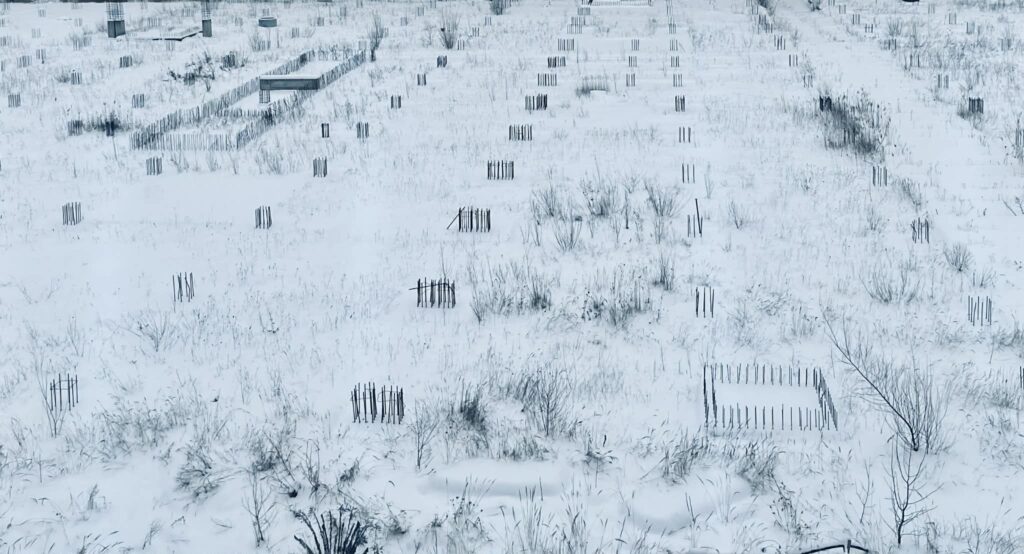
I’m staring out a window at a wintry Lviv field, waiting for the next scheduled power outage of the day.
I’m on a treadmill that creates the illusion of movement while keeping you firmly in place. It’s a fitting metaphor for my nature and my obsessive tendencies.
Fernando Pessoa once wrote, “I relive continually the same emotions, the same ideas, the same anxieties.”
I’ve lived a life of obsession. Not in the usual sense—not mastery, not completion, not encyclopedic devotion—but something quieter and more selective. From an early age, obsession became a way of narrowing the world until it felt manageable: The Hardy Boys. [Hockey. The Who. R.E.M. Guided by Voices. Georges Simenon. The pattern was always the same. I’d fixate on an artist and start buying the books, the records, the VHS tapes, or DVDs, stacking them neatly—and then I’d run out of steam. I rarely finished.
I used to think that was failure. That I sucked at obsession. But it wasn’t failure. The pleasure wasn’t in finishing; it was in knowing the rest was nearby. Obsession wasn’t excessive preoccupation so much as carving out a sanctuary—a place where everything was familiar, where I felt safe.
I’ve often struggled to explain why I loved certain things—Guided by Voices, Nick Tosches, Richard Meltzer, Buster Keaton. The explanations always sounded thin compared to the feeling. It wasn’t really about influence or craft. At times it felt like it was me seeking an identity, a posture, a place. A way of standing in the world.
There was something partial about these obsessions. I wanted the shape of things more than see their completion. Obsession became an environment rather than an achievement—a closed system I could step into when the world felt too loud.
When I was young, I made a mixtape consisting entirely of “Eye of the Tiger”—the same song, over and over. Later, in university and early adulthood, that focus shifted. I became obsessed with films—Hitchcock, Bergman, Woody Allen. I watched the same films repeatedly over the years.
I told myself it was about uncovering something I’d missed. There was some truth in that. I do tend to miss meanings and often need multiple viewings, listenings, or readings. I can finish a book or film and immediately struggle to recount what the hell the story was, let alone any deeper meanings.
But repetition wasn’t really about comprehension. It was about security—returning to a familiar world where nothing surprised me, where the rhythms and moods were already known. Repetition didn’t bore me; it steadied me. Each return felt like stepping back into shelter.
Love followed the same pattern. When I met someone who hit me—romantically or as a friend—I wanted to know everything about them. I wanted to absorb their history, their gestures, their contradictions. It wasn’t curiosity so much as immersion. They became another system, another world I could enter.
The problem with this, of course, is that you end up placing people on a pedestal. You don’t see their humanity. As their warts emerge, you feel they’ve let you down. You resent them. You feel they failed you. But that’s nonsense. It just means they were like you. What felt like disappointment was often just the slow discovery of ordinariness.
Maybe I was obsessed with becoming something impossible instead of accepting my own flawed humanity. Maybe accepting that is what allows you to be more forgiving—not just toward yourself, but toward others.
Alcohol was another obsession. Was I, am I, an alcoholic? I honestly don’t know. I can stop for days, weeks, months, even years. But when I do drink, it’s never one or two. It’s four or five or six. And then a binge period often starts. Soon, your head is filled with planning as a safeguard.
I won’t drink this much.
I’ll only drink on these days.
At these hours.
Only whisky.
Only beer.
Only wine.
The planning never stops. It mostly fails. It becomes exhausting. It eats your mind. Why not stop at one or two drinks? Because you don’t want the buzz to die. That means being left with yourself again. Maybe it’s the same with a Guided by Voices album or song. You keep playing it because it keeps you away.
That’s not to make it all sound dark. These books, these songs—and okay, less so the drinks—gave me pleasure. They gave me a kick I wasn’t finding anywhere else, except maybe through running or boxing. There was real enjoyment there. Real energy.
Another thread ran alongside all of this. For years, I was obsessed with my past—finding my biological father and my missing family. It followed the same logic as everything else: if I could find them, it would solve me. I’d finally know who I was.
A couple of years ago, I did confirm who my father was. Aside from some distracted time spent looking up interesting ancestors and forming a real relationship with a newly discovered great uncle, it didn’t actually do very much. The mystery dissolved, and so did the promise attached to it. It became clear that it was never really about the past itself. It was about the process—the sense of solving a crime. The obsession gave me something to chase, something that kept me from facing a very real present as a father, friend, and partner.
So I found my past, but I lost the present.
The volume of my obsessions has lowered in recent years. A long-term relationship collapsed after nearly a decade. I’d spent those years divided between two cities, and when it ended, I realized I essentially had no home. I stored what little I had left in my office and began purging—books, music, objects. Slowly. Deliberately. It felt fantastic. Light. Liberating.
Today, being a year and a half shy of sixty and living part of my life in Ukraine has only intensified that feeling of lightness. I don’t care much about stuff anymore. My youngest son now has domain over my Guided by Voices CDs and albums. I started buying the albums during the pandemic, telling myself it was a way to appreciate Robert Pollard’s collage covers. Again, there’s some truth in that. But mostly it was about building more walls, more safety, more places to hide from collapsing relationships and endless paternal guilt.
And what’s the point of that guilt anyway? It doesn’t help my sons. All I can do is be there—check in, let them be who they are, make sure they know I’m there.
Maybe this has been the struggle all along. I’ve felt the need to connect with people, to be social. I’ll sometimes moan about loneliness. But over time, I’ve come to realize that, for the most part, I actually like being alone.
That realization comes with context. My entire life I’ve struggled socially. I make terrible first, second, and third impressions. I often come across as cold, smug, arrogant, rude. And it isn’t any of those things. It’s overload—too much noise, too many cues, too much expectation, too much to process at once.
Seen that way, solitude isn’t failure or retreat. It’s relief. It’s where the pressure lifts, where I don’t have to perform or interpret or brace myself. It’s where I can regulate, recover, and think. Writing—my other obsession—is where I can hide away and try to decipher life on my own terms.
The question was always how to make my life as pleasurable as these obsessions made me feel. How to sustain that intensity without constantly borrowing it from something external. How to live, rather than sample.
I don’t think obsession like mine ever really disappears. It just changes shape. Some loops loosen, others tighten. What matters now is noticing when repetition becomes refuge and when it becomes avoidance. I’m still learning the difference. Some days I manage it. Some days I put my headphones back on and step onto the treadmill.