My history with the New Yorker Cartoon Caption Contest
The Science of an Obsession
Monday mornings, I copy an image from the New Yorker website, and paste it to Michael Murray’s Facebook account. It’s a cartoon missing its caption. I do this because Michael did it for years, and some of us are still addicted to the New Yorker Cartoon Caption Contest: the party that starts first thing Monday mornings.
You might say I’m obsessed.
Let’s see if science can shed any light on how obsessive behaviour is nurtured. A good place to start is often the animal behaviour labs. Have they got anything to help our understanding?
Oh look! Someone places a key in front of a chicken.
When I first met Michael, he gave me his business card: “Michael Murray, From a great height. I skipped Grade 4.” It was, obviously, the beginning of a magical friendship.
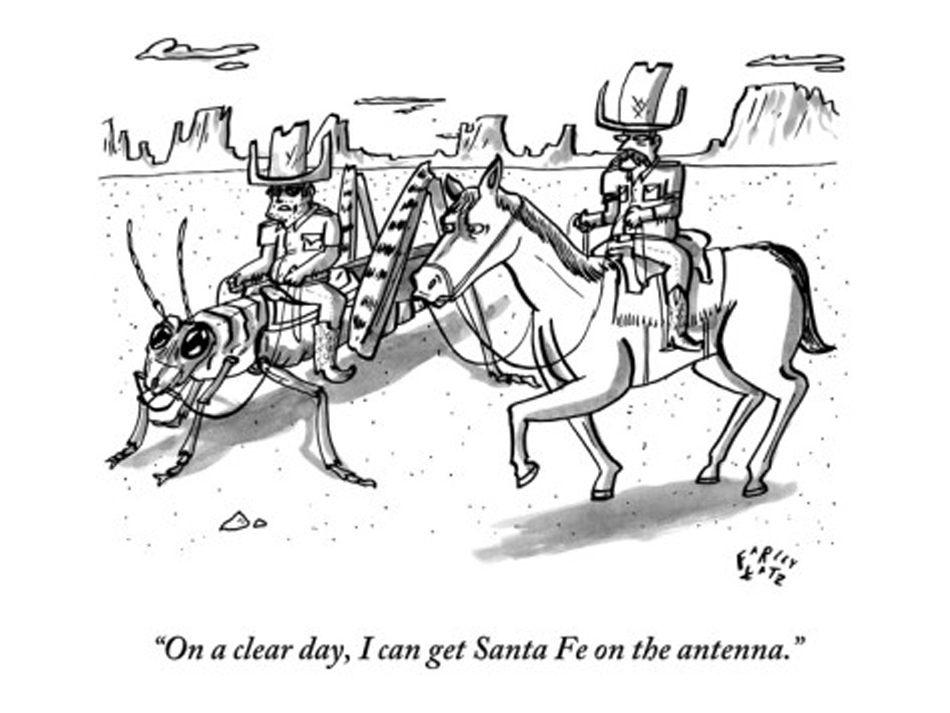
Around 2011, Michael set himself a goal: win the NYCCC. Floated by his belief in his own genius (that was never captured on IQ tests, apparently), he was obsessed: he wrote about it, submitted faithfully, bellyached when he didn’t win, derided winning captions and the decision-makers. And the following year, as he always knew he would, Michael won! … with a great, clever, killer caption.
What a thing! What a point of pride! He may even have changed his business cards from skipping grade 4 to winning the caption contest!
That chicken pecks the key once and gets a delicious pellet.
Okay, new goal! Michael started a movement for everybody in his phalanx of online friends to win the contest. He thought (incorrectly) that winners were barred from submitting. So, Michael wanted us to submit, to win, and be barred from submitting ever again! Hooray! What a heroic narrative arc. (Actually, you can win more than once, like this Larry Wood guy, who reportedly won 8 times.)
Michael posted the cartoon every week on Facebook, and many of us diligently shared our captions.
Science Lab, is that chicken special?
No, other chickens can peck too, and will get a pellet.
Every Monday, it was first thing I checked. I love puzzles, and that’s really what the NYCCC is. What’s a different angle, or the best wording? I tried not to worry about how bad some of my captions were, but it was hard to tell. You could gauge a caption by the likes, but often the ones I thought were good were passed over, while stinkers stacked the thumbs ups. No accounting for funny, it seems.
It’s generally agreed that getting a “Submit!” comment from Michael on a caption could make your whole day.
And that’s key: you’ve gotta submit. We both thought it was important to have that personal stake in the competition.
I came in second one time in 2014 with a caption that I’m pretty sure even I didn’t “get.”
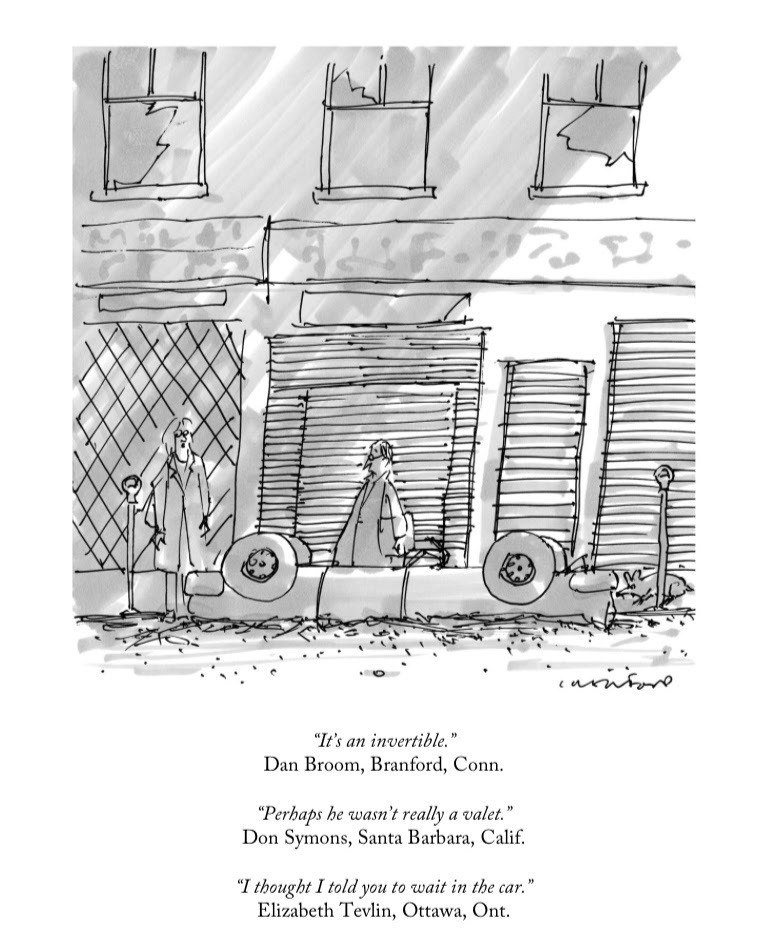
New Yorker captions are not something you can train for and get better at, but a few things stand out. Forget the obvious pun, if you can, or at least get through it to the next idea. They’re looking for a caption where the reaction is: raised eyebrows, a nod, and a “hunh.” More of a smirk than an LOL, because a knee-slap might spill your martini.
Meanwhile at the Science Lab, the chicken has to peck two or three times for the reward.
The chicken gets the hang of it.
Sometimes what you think is just a placeholder actually places, like this one that also took second, in 2018. I guess I liked it enough to submit it, but still…?
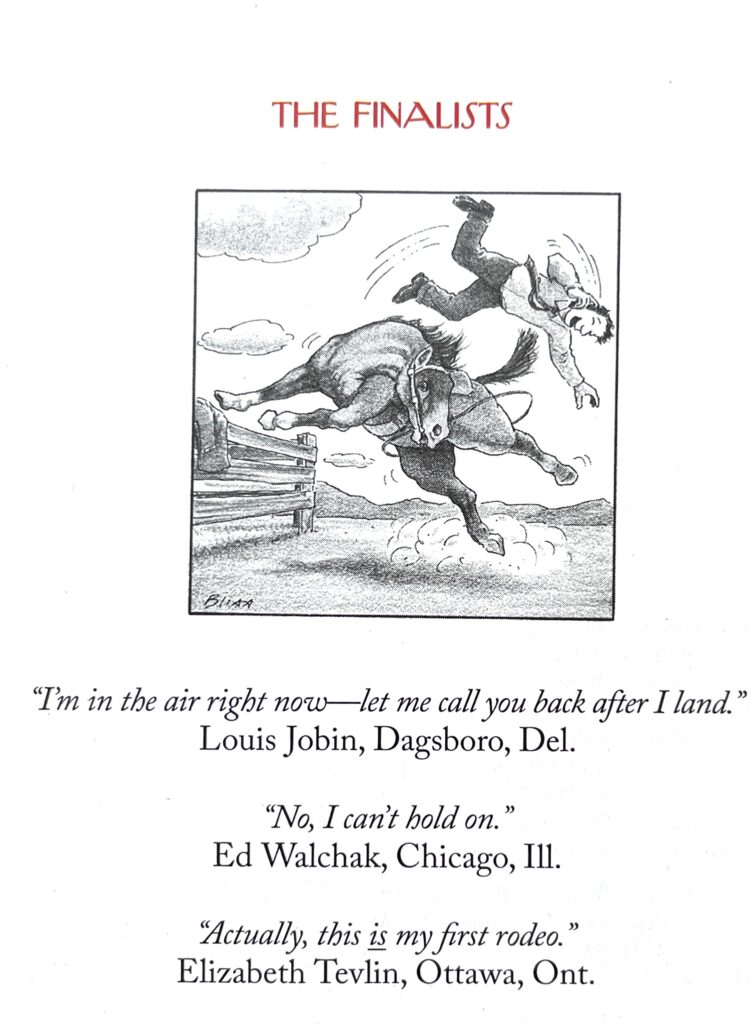
Between 5,000 and 10,000 people a week send in captions to the NYCCC, (with upward of a million votes on various captions), and our group had pretty good numbers. Another of Michael’s friends had won, and we had another winner and a couple of finalists among us. Basically, we were taking over!
In 2022, I won. Again, an ok caption, but I’m more of a dog person.
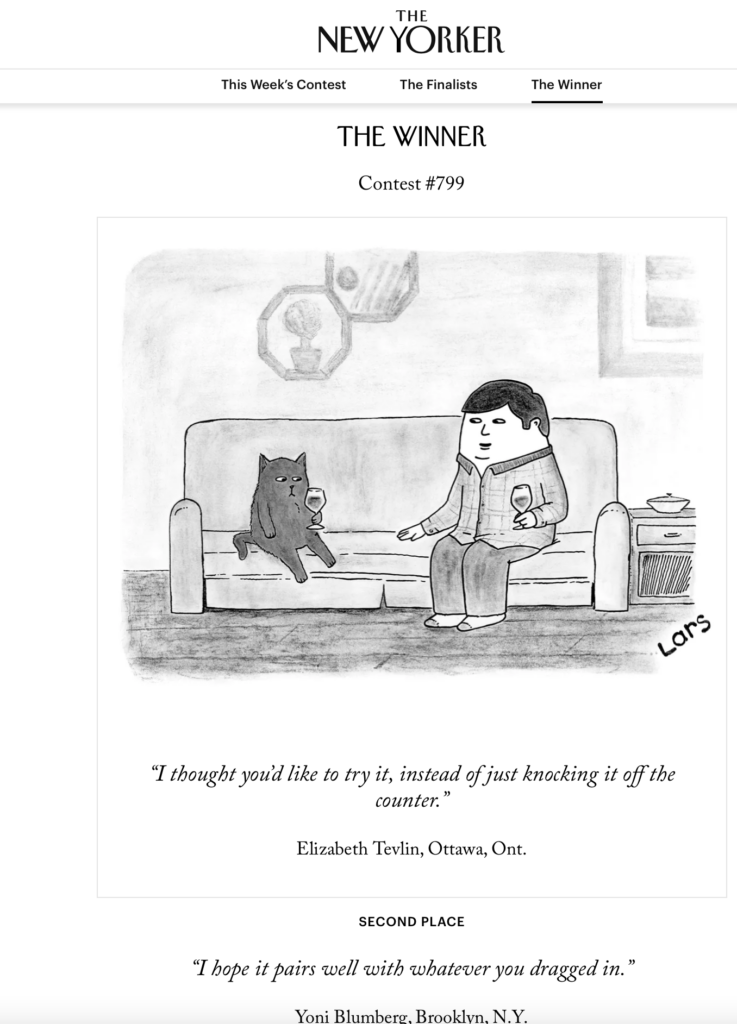
So, what is obsession? Maybe it’s some kind of a drive that overrides practicality. Maybe it’s persistence. Years later, I still enjoy the NYCCC, and if that longevity makes it an obsession, it’s one I inherited from Mr. Murray.
Here’s where science gets tricky with the chicken.
Chicken pecks. The pellet doesn’t arrive after two, or even three pecks.
In fact, the chicken doesn’t know when the pellet will drop, so it just…keeps…pecking.
For the chicken at the behaviour lab, the most enduring schedule is the random one. Without knowing when the treat is coming, the chicken “persists in pecking at a high and steady rate, hoping for the next treat.” Behaviour trained through random reward is hard to extinguish, apparently. I mean, ya just never know!
Two sleeps til Monday morning. Maybe, I’ll get that pellet.
Late breaking news:
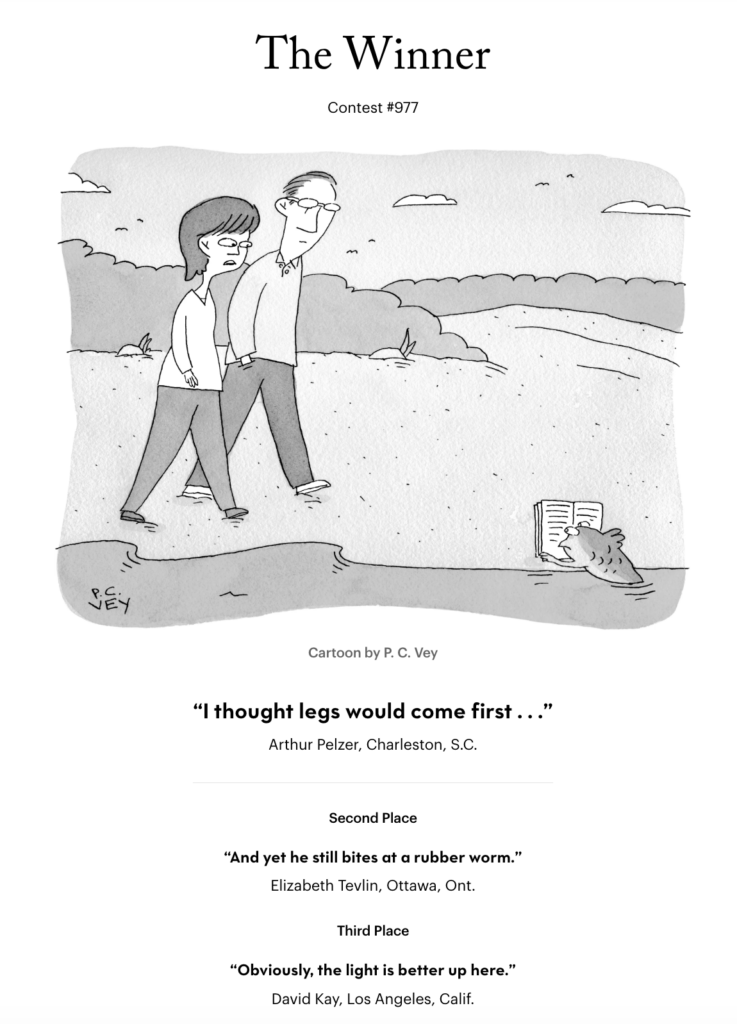
On Feb 4, I got an email from the New Yorker saying that my caption for a recent ‘toon was chosen as a finalist! I wish MM was around, he made it so fun.
Just today I learned this caption earned Second Place! That brings my overall stats to 1 win, and 3 second places. Now, where is that next pellet?

Elizabeth Tevlin

ET is a writer and painter living in Ottawa.
I wrote this little number at the request of this issue’s editor, Tony Martins. I’m not used to tooting my horn in this way, except sometimes. And this toot belongs to Michael and all the NYCCC contributors too!