
Teapot Tornado
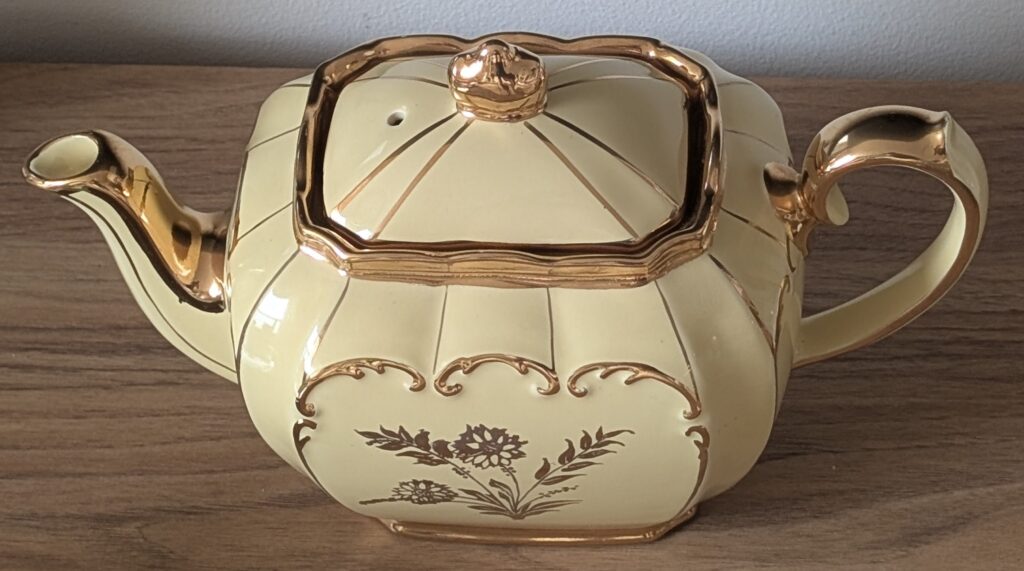
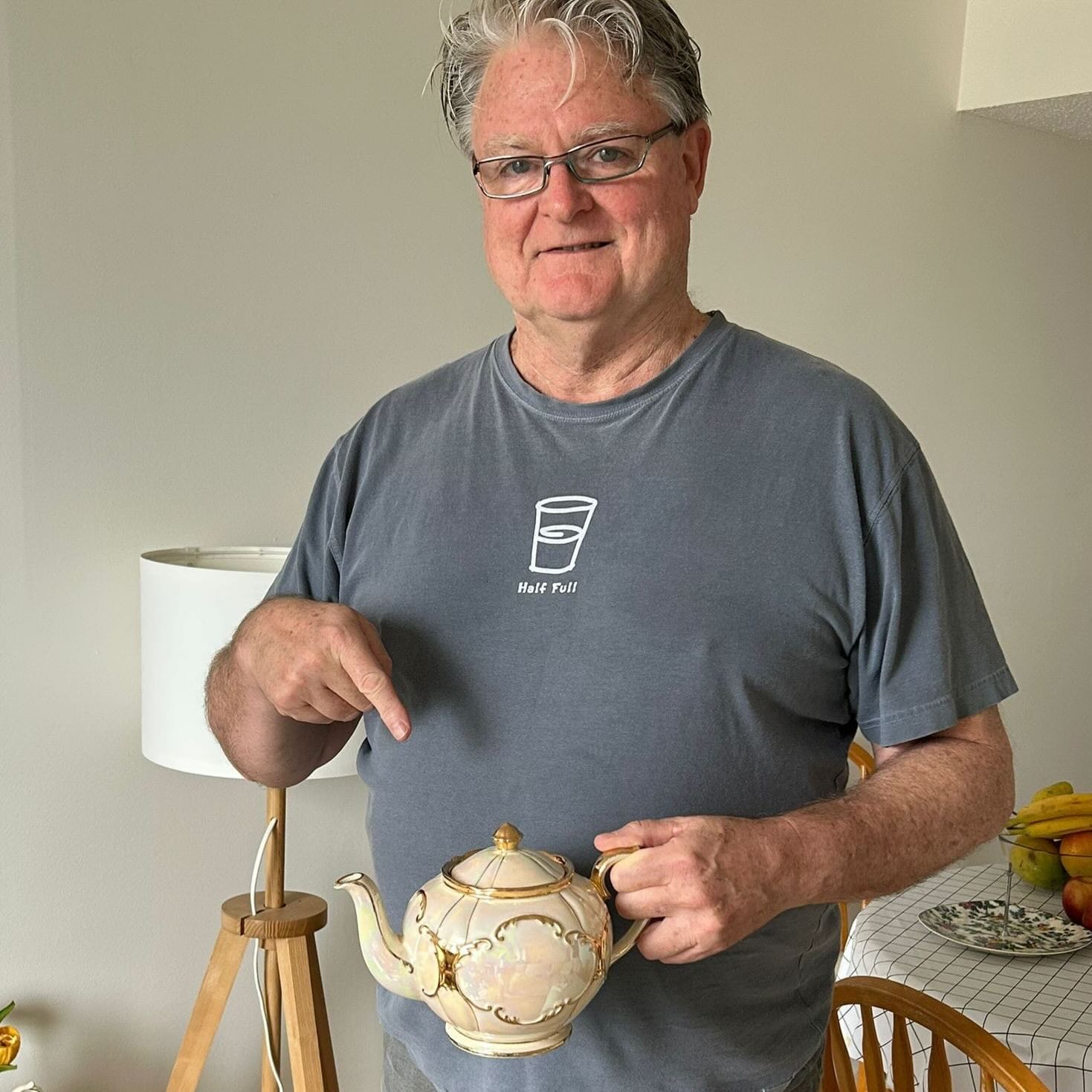
My wife brought it in the door one afternoon and quietly placed it on the sideboard.
It looked nice enough, with its smooth, gleaming surface, curvaceous body, and rounded belly, but nothing special. Not like an old book or vintage magazine. I did however like the way the light hit it from the window highlighting its gilt.
That evening, sitting on the couch, I found myself looking at it again. A pleasant sort of calm came over me and with it the slow realization that this thing, now under lamplight, was actually quite beautiful; its shape seemed sublimely suited to its function, for one thing. Perhaps it was my British heritage that explained the dawning appreciation. Thoughts of those who survived the London Blitz during WWll staying calm under fire with warmth and friendship offered to each other. The consoling conversations, and companionship. The kindness. A benevolent, soothing voice saying “Fancy a cuppa tea, dear?”
Clearly, this teapot was doing something more than just being nice enough. It was dancing with my psyche, pouring out memories.
The pot made me think of my peripatetic grandmother. She lived in Lewes, in Sussex. I visited her during the seventies. We watched the Frost-Nixon interviews on TV together. She used to drink lapsang souchong, a tea I still love. It’s got a great smokey flavour. Prior to Lewes she lived in the Channel Islands on Sark with my grandfather who was the doctor on the island. They had a Manx cat named Kelly. Nana took a scotch and water every evening at five. She lived to 99. Come to think of it, I like my scotch smokey.
All this came to me just from looking at the teapot.
It now occurred to me that this object really was something special; that maybe there might be something more than just books in the world to collect.
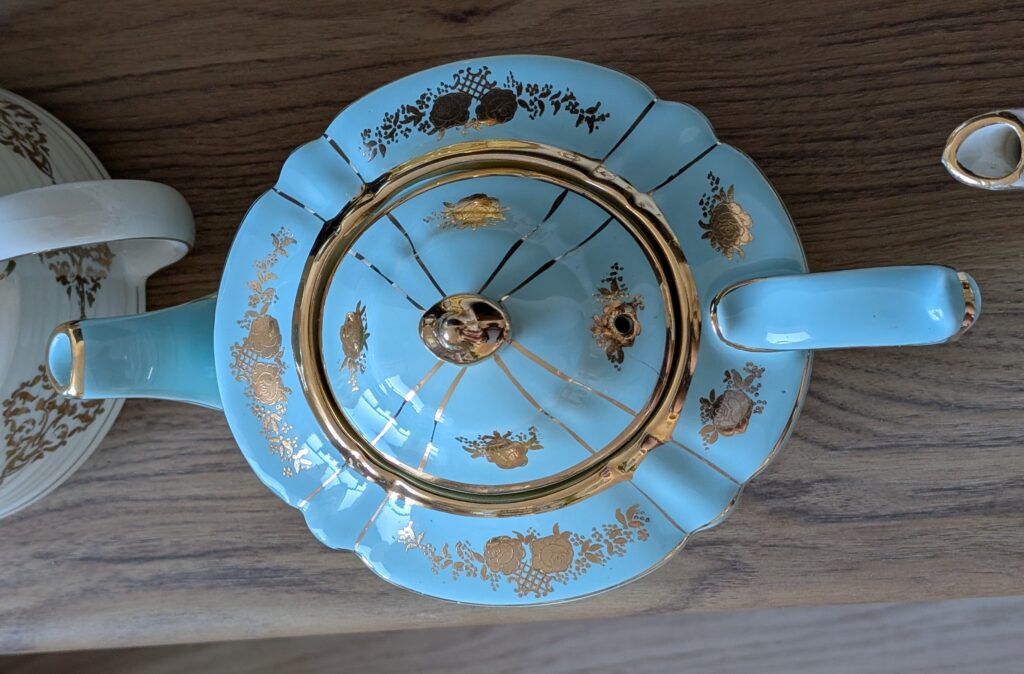
I’ve collected books seriously for about 25 years. Prior to that, appallingly, I just used to read them. With collecting came the understanding that books were more than just words on paper. They were special objects, desirable in themselves.
Collecting ideas often begin with exactly the kind of fascination I’ve described above. They’ll hit you out of the blue. I’ve never collected anything like teapots before. Not that the urge is foreign. A spark of delight, a memory that brings up a warm association, an appreciation, an understanding. Then a desire. I’m familiar with all of this. It’s in the genes. At any rate, looking at the teapot made me feel very good. It triggered some strong emotion, and for some irrational reason this flipped the switch. If one made me feel this good, just imagine dozens.
I had to have more.
Hunting teapots turned out not to require a big change in lifestyle. My wife and I were already visiting thrift shops and antique stores looking for vintage magazines. Teapots would be an easy bolt-on.
Not just any old teapots mind you. More like the first one we’d both fallen for.
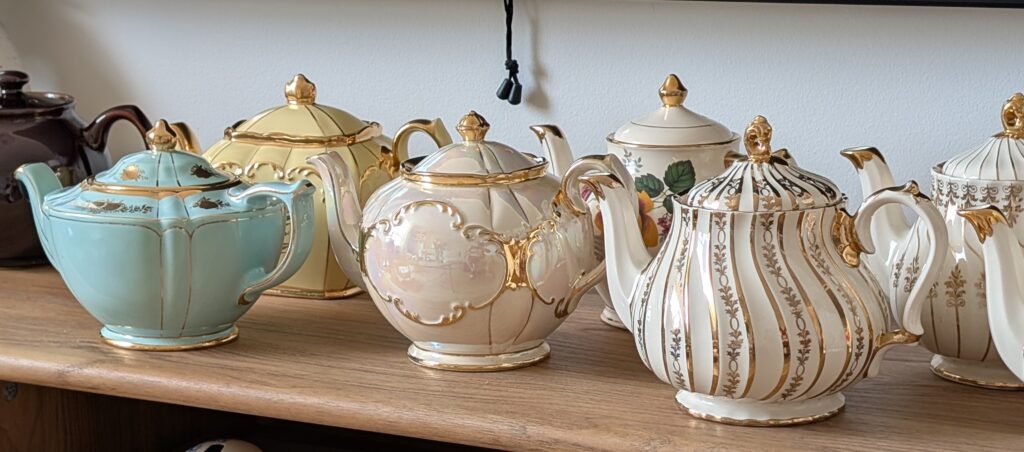
It was a Sadler, most likely made between 1937 and 1947, manufactured, definitely, in Burslem, Staffordshire, the heart of teapot-making country in the U.K. On its bottom, in “raised” type, were the words Made in England and Sadler written in a circle, along with four small numbers hand-painted in gold. Information found on the Sadler Facebook group forum I joined confirmed all this. So off we went looking for more. The tornado had taken hold.
Now, after just four months, we have forty. We went off-label in a few instances (Arthur Wood & Sons for one, and Sudlow, which are actually produced by Sadler, for another) just because these odd sods were irresistibly appealing. However, all of the pots we’ve acquired live within the realm of what you might call “the traditional.” Sadler is in fact well known for its novelty teapots – racing cars teapots in particular. They can easily fetch $200 to $300 each, but they’re not for us. We want pots that pour our teas elegantly, naturally, and easily. We want something purpose-built, not some fancy grand-prix substitute. Not that getting one is out of the question, but I’m not driving out of my way to find it. If a hot rod shows up at a good price okay. But, we know what we love, and we’re sticking with it.
Making these kinds of decisions is really what collecting is about. Discerning what you like and don’t like. What’ll make the cut and what not. Learning about your personal tastes. Putting words to your likes and dislikes. Understanding what draws you to some things and not to others. Self knowledge, in short.
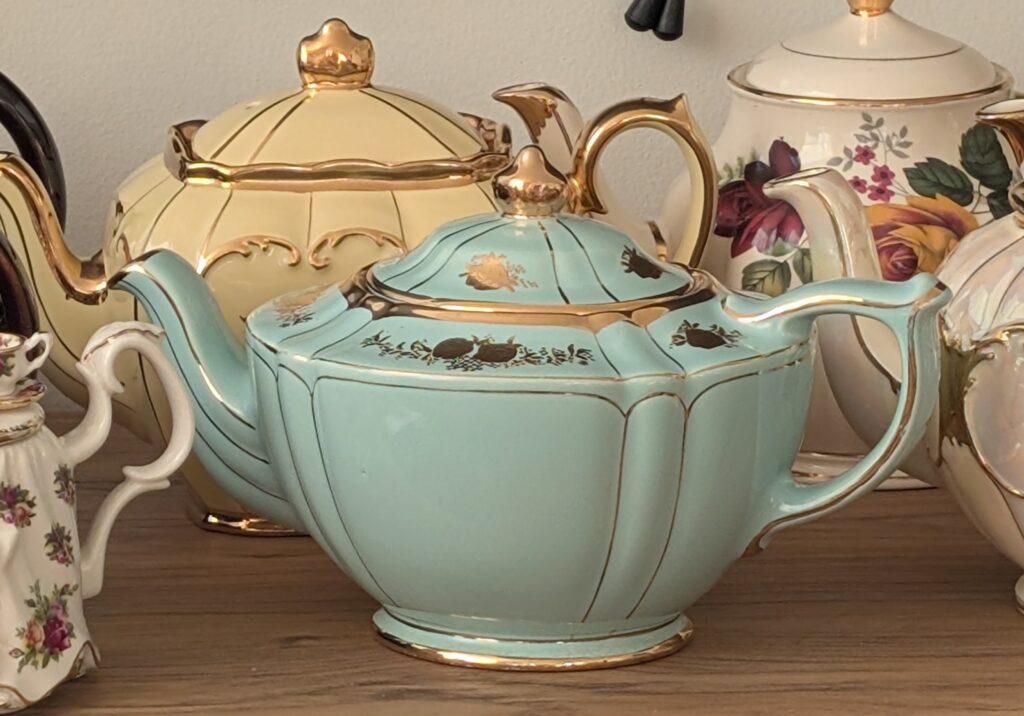
While collections speak of loves, interests, goals, and obsessions, collecting itself can, as I say, evolve into a journey of self discovery. Many may dismiss it as just accumulating clutter, but I think that collecting can serve an important, useful function, one that provides answers to some of the most fundamental questions we can ask of ourselves: who am I? What do I value, and why? What makes me happy? Collecting directs you to things you admire. The trick is to understand exactly why. It also guides and prompts you to act. To spend time doing what humans have happily done for centuries, to get out and relate to the world.
Collecting entails more than just acquisition and accumulation. It’s equally about observing, reflecting, learning how to care for things, how to store and preserve them, tracing their origins and significance. For some, collecting goes even further. It morphs into a spiritual, philosophical practice — a method of finding coherence in the world, understanding history. Furthering civilization!
Collecting is a way of life rooted in curiosity, driven by an urge to make sense of the world by gathering important fragments of reality. But it isn’t just about objects, it’s about lives, stories, patterns, and a deeply human impulse to assign meaning; it’s also a conversation you have with yourself, other like-minded people, and the world. Plus, it can take you to all sorts of weird and wonderful places you’d never otherwise visit.
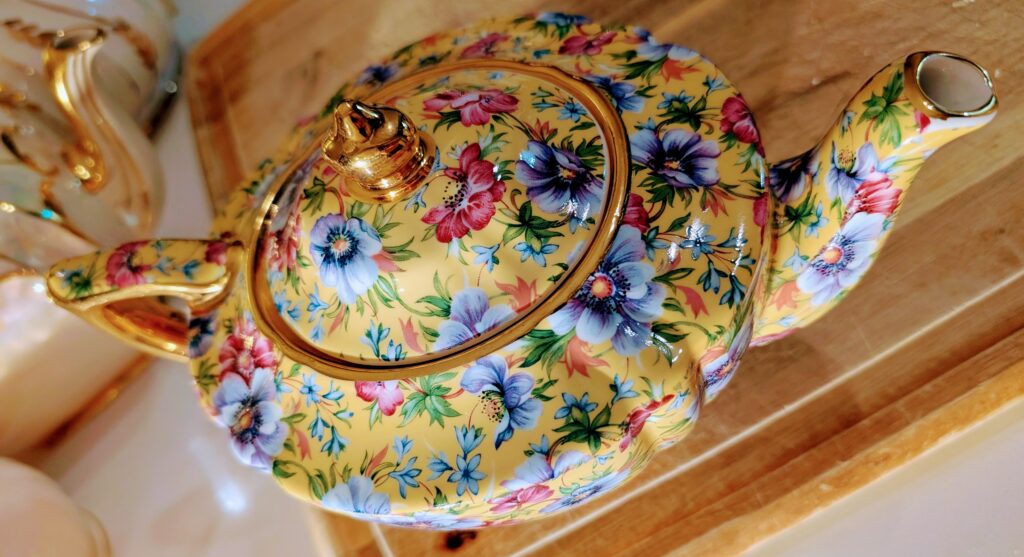
I’m often seized by new collecting ideas, a tingle sparked by an appreciation. Beauty often does it. And then there’s the urge to own and know. Loving an object for its aesthetic value often goes hand-in-hand with a desire to learn. But what about the urge to own? This is something less rational. It might have to do with the wish to be surrounded by beauty, yes, or wanting a critical mass to study, or maybe it’s the power and prestige associated with ownership, I don’t know exactly. One thing I do know is that in pretty well every instance, when I make a decision to buy something, it’s because I think it’s good value for money, and that somehow, some way, I’ll be able to make a monetary profit.
Now this part is irrational. Because, although I’ve bought literally tens of thousands of “treasures” during my lifetime, I’ve only ever sold any of them for a decent profit maybe half a dozen times. The joke is that my investment philosophy is to buy high and sell low. How do I make $1million? By starting out with $10 million.
I do however, despite being in the poor house, love how this irrational urge leads inevitably to detective work (comparing and contrasting the things I’ve bought, for example) — helped immeasurably by AI these days I should add — which in turn enables me to map out the path ahead, the parameters and targets which advise the hunt, and inform me when to pull the trigger.
This teapot thing really came out of left field for me, but maybe not as much as I think. As I say, I’ve got the genes for it. My great, great uncle was one Sir Arthur Church (you can Google him). It’s print culture that’s captivated me most of my life, not freaking ceramics.
Teapots are of course a different bird. For one thing, how the hell are you supposed to store them? Not in stacks, that’s for sure. Maybe AI will come up with a solution (speaking of which, one thing AI won’t ever be able to replicate is authentic vintage magazines, or teapots).
Anyhow, I can’t wait to learn more about them. Still, as it stands, I’m getting huge satisfaction from just sitting in front of them, staring, shaking my head, and admiring their sheer loveliness. Honestly, they’re worth every penny spent on them (hopefully more).
It’s like the first day I met my wife. I got off the bus in this sleepy little Czech town, looked at her, and immediately felt really happy. A strange calm settled over me as I admired her loveliness, it felt so great to just be in her presence. Still does. When I learned that we shared a love of books, and of visiting bookstores, I knew my hunt was over. But our happy hunting together has just begun. I hope it lasts forever.
Collecting isn’t just a hobby for us; it’s a way of life, a way to put in great time, to play in the past and enjoy the present. A way to relate to the world, and journey towards wisdom. Live in the moment, and admire human creativity. Like storytelling, it’s a fellow’s way of fooling himself, creating trouble, finding serenity. Pretending he controls the chaos.
Nigel Beale
Nigel Beale is a leading voice on collecting and travel for book lovers. For more about him, visit nigelbeale.com.